Laboratory of Magnetism
Institute of Physics, Slovak Academy of Sciences, 84511 Bratislava, Slovakia
Work Information
The laboratory of magnetism facilitates experimental material-research of
soft magnetics. The measuring setups are adapted for materials prepared into
the toroidal or the ribbon form. The range of methods in function to the date
of this issue comprises:
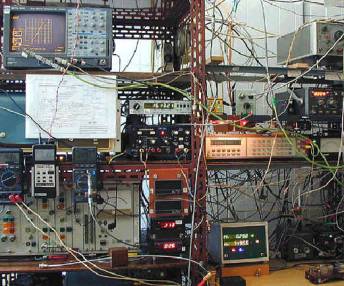 Hysteresisgraph:
- provides automated recording of repetitive or single-shot a.c. hysteresis
loops using equidistant sampling with numeric integration and/or analog
integration method. Characteristic parameters as losses (to 100 kHz), dynamic
coercivity, remanence, saturation induction, etc. are evaluated simultaneously.
Amplitude permeability (or susceptibility measured on open samples):
- PC controlled set-up enables investigated B, J or m, c vs H variation in
range 0.001 ¸ 800 A/m or 0.1 to 4000A/m. The same vs f variation in the range
10 Hz to 0.3 MHz.
Disaccommodation of the permeability:
- the variable set-up enables to trace magnetic aftereffects from 0.5 s as H
variation (f is from 10 Hz to 1 kHz).
Incremental permeability:
- The primary of Helmholtz coils is energized by a dc current to provide the
field Hdc. The
longitudinal incremental permeability is evaluated from the impedance of a
pick-up coil fitted to the Helmholtz pair. Using a 770 Hz sine ac excitation,
we use the constant Bac
mode; this of course reverted to a constant Hac
by approaching saturation with the field Hdc. Low ac fields with a
maximum of 0.4 mT and 0.3 A/m respectively.
Sample preparation and technology:
The investigated materials come in form of as-cast ribbons. The following
refers to toroids and strips (maximal long 10 cm):
· Toroid
construction: winding the core under controlled stress, encapsulation or
box-protection after thermal treatment.
· Thermal
treatment at Ar atmosphere to 600°C of toroids or strips.
· Thermo-magnetic
treatment with axial field (for strips) up to 550 A/m, other conditions as
above one.
The density measurement of small samples (thin metallic ribbons):
The density determination is performed by the buoyancy method (Archimedes'
principle) in a liquid. The method attains resolution better than 0.5% around r
~ 8 g/cm3 for nonporous metallic samples as small as 0.005 cm3.